
Monthly Archives: April 2019

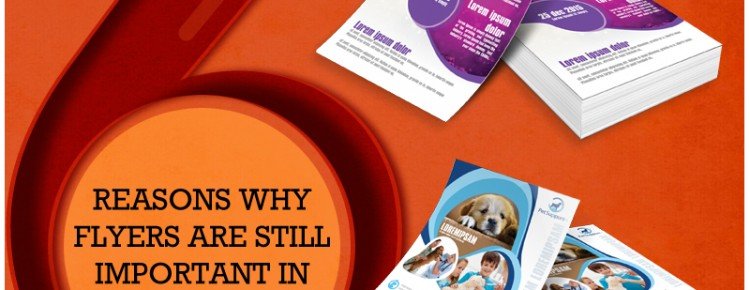
6 Reasons Why Flyers are Still Important in Marketing

Marketing

Flyers are considered as one of the oldest forms of marketing. Due to the advent of digital advertising medium, online marketing platforms like email, social media, etc. have become an essential part of marketing strategies nowadays. However, many companies are still using flyers as an effective medium of marketing. Experienced marketers have even suggested that brochure is one of the most important tools for offline advertising.

Advertising that utilizes effective flyer design is a budget-friendly option to deliver your products or services to your target audience. If used strategically, flyer distribution campaigns can provide you with unlimited clients.

The reason why flyer is still not outdated is that it suits all types of businesses and can help them achieve their marketing goal in the best possible manner. Apart from that, there are many other reasons why most people consider flyer marketing as a useful tool for offline advertising.

Flyers are Relatively Cheaper than Other Online Advertising Methods:

When it comes to choosing the option of a flyer, business owners need to think about the concept as to how the flyers can be useful. The first step is vital as you need to discuss with a team or other likeminded people. Once done, you need to come up with an outline of the flyer design. Once the initial ideal is finalized, you need to hire a professional designer to draft the flyer design for you. It is effortless and much cheaper than running an online Advertising campaign or booking an advertisement online.

Easy Access to Your Potential Consumer:

With offline advertising medium like flyer, you can reach your potential consumers very quickly by applying the minimum effort. Unlike online advertising, where you need to make a detailed plan about how to target your potential customers online, you can easily place your flyer at different locations of your choice or distribute them among your customers by your own. This ensures easy access to your customers as a large number of people can view the flyer on the go, or they can go through its content on their way to home or office.

People Easily Get Attracted to Flyer:

Despite the overuse of online advertising mediums like banners, websites, social media platforms, etc., flyers still can grab the attention of people. Because of their unique design, people easily get attracted to flyers. Therefore, it is vital to create a uniquely designed flyer that can draw a thousand eyeballs.

Instant Feedback:

One important reason why most people still love flyer advertising is because of their ability to reach across to the correct audience in no time. Unlike online marketing, you don’t need to sit and wait for the results as people who get the flyer in hand give an instant reply. All you need to do is to distribute the flyers among the correct audience.

Compelling Art Form:

Flyers are a valid form of art as your target customers cannot even get a chance to overlook its contents. This is because people tend to read what is around them. When it comes to online advertising, there is a pretty good chance that a large portion of your targeted customers does not pay much attention to your ads. However, when people are at their workplace or in some other place, they surely read what is around them. Therefore, it is vital to create an effective flyer design that accurately conveys the right message.

Add a Personal Touch in Advertising:

When you are distributing the flyers in person, it can create a personal relationship with your targeted customers. Each time when the prospect will look at the flyer design, it will remind them of your promotional message. This adds a personal touch to advertising, and this is something that online advertising doesn’t offer.

Flyer advertising gives businesses a chance to promote their business within a limited budget and helps them generate real results. The success of flyer advertising most depends on the venue you choose for distributing the flyers. It is also essential to design your flyer in such a way that it grabs the attention of people and controls their will to purchase your product or use your service.
Why A Premade Logo Isn’t Good Enough For Your Business?

Why A Premade Logo Isn't Good Enough For Your Business?

When it comes to design a business, many people prefer to use pre-made logos that are commonly available online. Most of these premade logos are available at a low price or event is free of cost. However, are these logos suitable for your business?

Before we come to the point as to whether you should use a premade logo or not, we first need to realize what a business logo is. A business logo is the identity of your business, and it creates an impression in the mind of your potential visitors. A good business logo should be designed by following your central business concept. The logo should represent your business values, core message, and the services you offer graphically. A properly designed logo should be memorable which can leave an everlasting impression in the mind of people.

What is Pre Made Logo?

As mentioned earlier, the premade logo is commonly available online. You can use these logos by slightly tweaking the font style, with your business name, etc. Some premade logo platforms also let users change the color to fit your style. The reason behind choosing these types of logos is because these logos are available at little cost, even free of charge. If you are on a tight budget, you can go for these logos, but it might not be the best choice for your business. However, if you are business with a vision and want to build an identity of your brand, then you should never use a premade logo as this will create a negative impression.

Mentioned below are the reasons why premade logos are not good enough for your business:

One Logo for More Than One Customer:

The main problem that comes with the premade logo is that you cannot make the right selection of your logo. Although it is against ethics, there are many readymade logo providers online that sell the same logos for some businesses. This is cheap and can damage your brand identity forever. This is not going to waste your money but can leave a negative impression in the mind of customers.

Logos without Exclusive Rights:

When you hire a professional logo design company, they will first listen to your concept and then come up with a unique logo design. The custom logo design that a professional logo design company creates for you comes with exclusive ownership rights, which you can never get with a premade logo. Premade template logos don’t have any proprietary rights, which can lead to unwanted trademark confusion with some other company.

Copy of another Design:

In most cases, a premade logo is made by copying the design of an already available logo design, with or without a little deviation. This creates a negative impression for a brand because if a customer sees that you are using someone else’s logo design, they will avoid your business. With premade logos, the uniqueness of the design is always lost, and it fails to show the brand value.

Designed By Unprofessional Designers:

The reason why these premade logos are available at little cost is that unprofessional freelance designers make them. Premade logo is never considered a sign of professionalism. The designers that are responsible for creating these premade logos are lazy, and they don’t do their job honestly. In most cases, they blatantly copy someone’s style with a little variation, which would never play well when used for your brand’s name.

No Design Customization:

Once you purchase a premade logo, there is no chance of customizing the same; even you don’t like something about the logo. Although some premade logo provider offers limited changes that you can ask for, they would surely ask for extra money for the same. However, this is not true when you are working with the professional logo design company. The professional logo design company offers a couple of versions of the same logo, and even if you are not satisfied with the style, you can ask for variations. The logo designers will always be ready to provide you with a free revision.

Considering the points mentioned above, it is strongly recommended that you avoid using the premade logos for your business. It is recommended that each company should hire a professional logo designer to create a uniquely customized logo that carries the visual identity of the brand.

Five Tips For Providing Your Designer With Helpful Feedback

logo designer

Feedback is an essential part of any design process, and if it is done correctly, it makes sure that the designer gets full success in delivering the best work. The design process is a collaboration between the designer and the client and to create a successful design; the designer needs useful feedback from the client. However, how to provide your designer with the most helpful feedback that ensures the success of the work?

As for the designer, receiving feedback from the client is often stressful. If it’s not bright or full of confusion, the design process may be hampered. On the contrary, giving feedback to the designer can also seem a difficult task on the client’s part as well.

Mentioned below are 5 essential tips that help you provide your designer with the most helpful design feedback as a client.

Be Honest While Working With the Honest:

It would be best if you kept in mind that you are working with the designer to create a magnificent work that is going to serve a genuine purpose for you. During the design process, the aim of the designer should be to provide with the best product that you are delighted with, and that will serve your purpose as well. Therefore, in the course of the design process, if you find something not up to the mark, then be honest and tell the same to the designer. If you cannot provide the designer with honest feedback, you can never achieve the ultimate result. It is much more helpful for the designer if they get honest feedback from you, even if it seems harsh.

Give a Specific Reason & Try to Give Examples:

If you don’t like something about the design, it is better to explain a little as to what you don’t want about the plan. This will be more helpful for the designer to understand your point as, without an apparent reason, they will be in darkness as to why you don’t like the design. As for the client, it is true that sometimes it can be difficult to accurately pinpoint the specific reason about what makes you feel wrong about a particular purpose. However, it would be easier for the designer to understand the feedback if you can describe a little detail – like how does the design make you feel, any specific part that you don’t like, e.g., the fonts, colors, background, banner, etc.

Although you are explaining your feedback in detail, there may be times when your designer has no idea about what you are talking. The best way you can get rid of this situation is to give specific examples so that it is apparent to your designer. This is especially true when you don’t have much knowledge about every aspect of the design, and you need to give feedback about the design work.

Ask Questions:

As the design process goes on, and the designer sends you regular updates, you may have moments when you see the design and have so many questions. Make sure to ask them to your designer. If you are not clear about a particular part of a design, ask the designer about what makes them include the same in the design and what purpose the specific element is going to serve. If the designer is concerned about your project, they will surely be able to answer your questions and give specific reasons as to why they have included a particular section in your design.

Consider Your Business Goals:

When evaluating the design and giving feedback about the same, you should consider looking at the overall design and think whether it is going to serve your business goal or any of your specific need. Imagine yourself as any of your potential customers and try to view the design in the eyes of a customer. If something is confusing in the design, you should immediately let the designer know about the same. Try to check whether the design gives you an overall idea about your business or the message that you are trying to spread through the design. If it is not delivering the purpose, be honest and tell the designer about this.

Give Realistic feedback:

If you are trying to get the right design that serves your purpose, you should always respect the designer’s effort and his/her choice. During the design process, you should still be realistic and treat your designer as a part of your team members. It would help if you never rushed and always give your feedback on time so that the designer has enough time to make all the changes according to your feedback. This helps you meet your deadline as well.

The more you are engaged with your design; the better will be the design work. The feedback is an essential part of any design process, and if you have a good relationship with the designer, the more likely you will receive a great design that serves your purpose.

The Ultimate Breakdown of File Types – Part 2

Ultimate Breakdown

The Ultimate Breakdown of File Types – Part 1

Mentioned below are some of the examples of Vector Format image files.

Scalable Vector Graphics (SVG):

This is a versatile vector image format which is commonly used for designing web pages as well as to serve other purposes. The main intention behind the introduction of the SVG file type was to create an image file type that can be used for all purposes. Since they are developed on XML, SVG file types are lossless and are considered as the most used vector formats available in the market.

Portable Document Format (PDF):

The renowned Adobe group developed this particular file type. You can view this type of file by using Adobe Acrobat software. However, Adobe Acrobat is available in free of cost, and you can easily download one and install in your system to run PDF files. When it comes to sharing any images, the PDF file is considered the most accessible tool and therefore, is the most popular vector file format in the world.

Encapsulated Postscript (EPS):

EPS is a favorite file type mainly used in vector based design by using Adobe Illustrator. Unlike the other vector file format, EPS file can be designed with text as well as graphics. Another reason why most people prefer to use EPS is that you can open these types of images by using any software and can edit easily. An EPS file is a postscript format and used in high-quality graphics and printing.

EPS is a unique file type as it offers a preview picture of the image being designed. The idea behind this to give the designer a simple preview of the end product. As EPS files contain many postscript printing commands, you can find an option in a printer device to save as EPS.

Adobe Illustrator (AI):

This is another essential vector file type which can be edited and created by using Adobe Illustrator tool. You can read this image file type by using Adobe Illustrator software only. Adobe Illustrator is also considered as the most popular software when it comes to design a vector image file. AI file type is suitable for using any projects, no matter whether it is a web page or printing project. Although the data contained in the AI format is mainly based on PDF, you cannot read this type of file in Acrobat. Whenever you create a design on Adobe Illustrator and save the file as .ai format, it instantly includes a PDF preview inside the file. This is the reason why AI format is the most preferred format by the designers when it comes to saving an image file.

The Ultimate Breakdown of File Types – Part 1

Ultimate Breakdown

If you look at the online marketplace, every graphic that you view, no matter whether it’s on a website or a flyer, comes from an image file. The marketers and designers should be well aware of different types of image files available in the market. There are many reasons as to why it is essential to get at least a bit of knowledge on the image file types.

You must be aware of the fact that not all image file types serve the same purpose. To select the best image file type, you must have a clear about where the image is going to be used. If the image is going to be used on a website, you need to know which type of website it is. For example, you may require a sketching or illustrative file for your website. You also need some particular kind of software to open a specific image file.

Above mentioned things are just a few examples as to why it is essential to have precise knowledge about the types of the image file that you choose for your business. Mentioned below is a discussion on different types of image files available in the market.

One of the most important things that you need to know first to learn about the image file types is that all image files are mainly categorized as Raster format and Vector format.

Raster Format:

Raster format is the image which is in a grid of pixels. Depending on the high or low-resolution images, the pixels in the picture have their proportions. As a result, if the image is stretched beyond its pixel capacity, it is likely to get distorted. Some of the commonly used Raster format image file types are PNG, JPG, GIF, etc.

Vector Format:

Unlike the Rastor formats, vector format is a type in which the images are not formed in pixels. Instead of pixels, vector format uses points, lines, and curves in a definite proportionate according to a mathematical equation. As result images of vector formats are more flexible and you can resize the same freely without distorting the same. Some of the examples of vector formats of images are SVG, PDF, and EPF.

Now let us have a look at the types of Raster Format image files.

Joint Photographic Experts Group (JPEG):

Of all types of image file types available in the market, JPEG or JPG is the most popular. The quality of a JPEG type image is directly proportionate to the size of the particular image file. This means the quality of the image is compromised as long as you compress the image. This is the reason it is essential to check the resolution of the photos before using it on the website or anywhere else.

Depending on the nature of your requirement, you need to choose the resolution of JPEG images. For example, if you need an image for DTP and printing purposes, you need to use a very high-quality JPEG image. The DPI required for this type of image should be a minimum of 300 dpi. On the other hand, you need to use a JPEG image of minimum 72dpi for a webpage.

Graphic Interchange Format (GIF):

In most cases, the animated videos are of very high quality and take time to load. The images used in an animated video are of high quality, and this is the reason the images used on animated videos are not suitable for web pages, where page loading time plays an important role. This is the reason why GIF images are used. GIF image types are mostly used in animated videos. As these types of format support 256 colors in RGB color space, they are relatively low in size.

Portable Networks Graphic Format (PNG):

PNG image file type is popular because of their lossless nature. This means you can compress or decrease their file size without compromising with the image quality. The reason why the PNG file type introduced was because of the need to overcome the limitations of GIF. In comparison to the GIF image type, PNG file types are of better quality and support more color. Another reason why most designers prefer PNG is because of their transparency. However, you cannot use PNGs for printing because they are of little resolution. PNG images work well with any webpages.

Above mentioned file types are few of the most popular Rastor format images. There are many other Vector format image files, which I will add to the list as well.